
Transit agencies rarely struggle to define impact. The goals are clear: reliable service, informed riders, efficient operations, sustained ridership. What is much harder is deciding which investments will actually produce those impacts in the real world.
Every year agencies procure systems, launch tools, and change workflows with the expectation that improvement will follow. Sometimes it does. Often it does not.Too often, transit initiatives jump directly from technology to impact. A system is procured. A tool launches. A workflow changes. Improvement is expected to follow. But technology does not produce rider impact. Human and system behavior do.
A new tool, dashboard, or data feed is only an intervention, an attempt to change how decisions are made, how operations function, or how riders experience service. If those changes do not occur, the investment has not succeeded, no matter how well the technology ships.
This is why transit agencies can spend millions on technology and still struggle to move ridership, reliability, or public trust.
This missing middle between intervention and impact is where many transit technology investments succeed or fail. Mapping the outcome chain makes that causal path visible.
The Outcome Chain
An outcome chain describes the sequence of changes that must occur for an intervention to produce impact.
The Outcome Chain Framework
| Framework Piece | Example |
|---|---|
| Impact: The mission-level result: ridership, cost efficiency, service reliability, equity. Important but not directly controllable by any single team. | The agency delivers paratransit service that is cost-efficient and reliable enough to sustain ridership demands. |
| Hypothesis: What we believe is standing between current conditions and the impact we want to achieve. If [outcome] is achieved, we believe it will produce [impact], because... |
If schedulers make consistent, well-informed trip assignments, the agency will reduce cost per trip while maintaining on-time performance and rider trust. |
|
Outcome Chain: Two or more linked behavioral or system changes. Each one is observable and measurable. Each one is a precondition for the next.
Each outcome is linked by a known or assumed cause. |
Outcome 1: Riders experience trips as reliable and book again with confidence.
🔗 Known or assumed cause: Rider trust is primarily driven by on-time performance, not by other factors like driver behavior or communication. Outcome 2: Schedulers make consistent trip assignment decisions across shifts and staff. 🔗 Known or assumed cause: Inconsistency is driven by uneven access to information, not by training gaps, policy ambiguity, or competing priorities. Outcome 3: Schedulers have accurate, real-time data about vehicle location, capacity, and rider needs at the moment a trip is being assigned. 🔗 Known or assumed cause: The data exists in the system but is not surfaced in a usable way during the decision window. |
| Output: What we build, research, and deliver. | A scheduling interface that presents trip-relevant data in the context and format that matches scheduler workflow. |
Each link in the outcome chain represents a measurable change in behavior or system conditions. Each connection represents a hypothesis about causality.
The structure clarifies four different concepts that are often conflated in technology initiatives.
Impact: A mission-level condition indicating rider and agency success, such as reliable service, sustained ridership, or cost-efficient operations. Impacts are influenced by many factors and are rarely controlled by a single team.
Outcome: Observable changes in behavior or system conditions that drive impact. An outcome can often be described as:
Examples might include:
- Riders adjust travel plans based on disruption alerts
- Dispatchers make consistent decisions during service disruptions
- Program administrators complete pass enrollment without support intervention
Outcomes describe what is different in the world, not what was built.
Intervention (Output)
The action an organization takes in an attempt to produce the first outcome in the chain. Interventions might include technology builds, process changes, policy shifts, or training initiatives.
An intervention is a hypothesis about what will produce change. It is not proof that change will occur.
The Missing Middle Between Strategy and Roadmaps
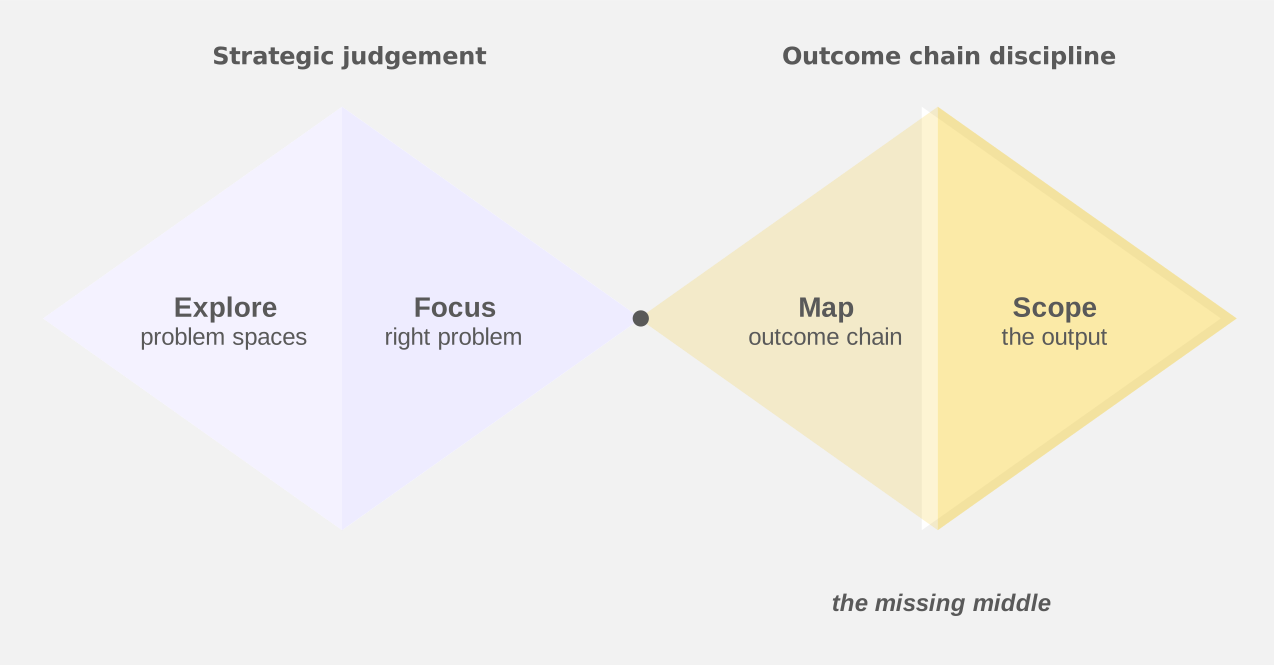
Transit leaders are typically comfortable thinking at two levels: strategic goals and operational work.
Strategic goals describe what the agency hopes to achieve. Examples include more reliable service, improved rider information, and better operational efficiency.
Operational work describes what teams will do. Teams procure systems, build tools, launch features, and update workflows.
Without something in between, the organization quietly jumps from goal to solution. A problem is identified. A tool is proposed. A roadmap is created. The intermediate question, what must actually change for this investment to matter, often goes unasked.
This gap also explains why many transit initiatives stall between departments. Technology teams build systems. Operations teams manage service. Communications teams manage rider information. Each group delivers outputs.
But if the agency has not defined the specific outcomes those outputs must produce, no one owns whether the intended behavioral change actually occurs.
The outcome chain exists to make that middle visible.
Outputs Are Interventions, Not Just Technology
In my experience in transit technology, the output layer is assumed to mean technology: a dashboard, an interface, a new tool, or a data feed. When a problem is identified, the conversation quickly turns to what should be built.
Outputs are better understood as interventions, the actions an agency takes to create change. Technology is only one type.
An outcome chain does not require a software solution. It requires a credible explanation of how a specific intervention will produce a measurable behavioral or system change that drives impact.
In transit agencies, interventions can take several forms:
- Technology: tools, interfaces, automation, and data systems
- Process: operational workflows and decision procedures
- Policy: rules, standards, and decision authority
- People: training, staffing, and incentives
- Procurement: vendor contracts, system ownership, and control
Each of these sits at the intervention layer. Each can produce outcomes. Each carries assumptions that should be made explicit before resources are committed.
When technology is treated as the default intervention, agencies often build tools for problems that are fundamentally organizational. A dashboard does not resolve unclear authority. An interface does not fix a broken process. Automation does not change incentives.
Mapping the outcome chain forces a different starting point. The question is not what should we build? The question is what must change for riders or the agency to experience improvement?
What Outcomes Look Like in Practice
Consider service disruption alerts. An agency might invest in improving the alerts interface or adding new notification channels. The intended outcome is not that alerts are redesigned. The outcome is that riders make different travel decisions because they trust the information they receive.
If riders still arrive at a closed station confused about what is happening, the outcome has not occurred, regardless of how modern the interface looks.
Dispatch operations provide another example. Agencies often invest in dashboards or monitoring tools for control centers. The outcome is not simply that more data is visible. The outcome is that dispatchers make faster and more consistent decisions that stabilize service.
If operators and supervisors continue relying on workarounds or personal judgment during disruptions, the intervention has not changed the outcome that matters.
Headway management illustrates the same principle. A system might show real-time vehicle spacing, but the intended outcome is not visibility alone. The outcome is that supervisors intervene early enough to prevent bunching and service gaps.
Visibility without intervention does not produce reliable service.
Assumptions, Knowledge, and Investment Risk
Every step in an outcome chain carries an assumption. For example:
- If dispatchers have the right information during disruptions, they will make more consistent decisions.
- If riders receive disruption alerts early enough, they will adjust their travel plans.
Some assumptions are grounded in knowledge. This knowledge may come from previous research, operational experience, or observed behavior. Other assumptions remain untested.
The distinction matters. When multiple assumptions sit unexamined in the same chain, the investment carries risk at several independent points. A technology intervention may work exactly as designed and still fail to produce impact because the behavioral change it depends on never occurs.
Mapping the chain does not eliminate uncertainty. It forces teams to identify what they are assuming and what they may need to learn before committing resources.
Make the Right Behavior the Easy Behavior
The outcome chain identifies whose behavior needs to change. The next obligation is to make that behavior easy.
This principle is frequently violated. A team identifies the right outcome but delivers an intervention that requires extra effort from the people expected to change.
- A dispatcher must remember to check another system during a disruption.
- A rider must navigate multiple screens to find the correct alert.
- A program administrator must call customer support to complete routine tasks.
The intervention may be technically correct. The behavioral change never occurs because the effort required remains too high.
The real work is not simply identifying the right outcome. The real work is making the desired behavior the path of least resistance.
Why This Discipline Matters
Mapping the outcome chain forces a discipline that many transit technology initiatives lack. It requires teams to explain, in concrete terms, how an investment is supposed to produce rider or operational impact.
The exercise does not guarantee success. But it exposes assumptions early, before agencies commit millions of dollars and years of effort.
Instead of asking what should we build, leaders begin asking a more useful question: What must actually change for riders or the agency to experience improvement?
When that answer is clear, better investment decisions follow.